


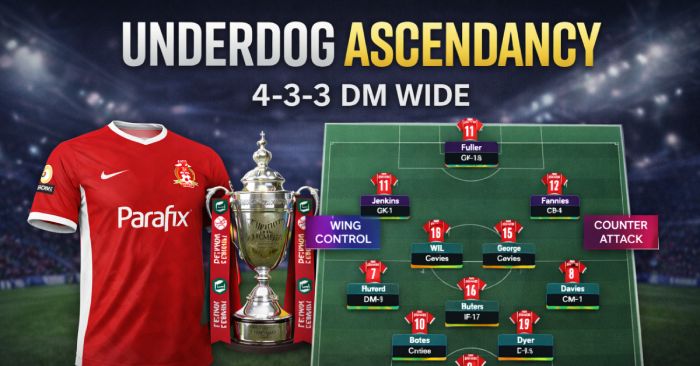
Structured wide dominance system designed to turn relegation candidates into champions.
Briton Ferry Llansawel – From Relegation Favourites to Cymru Premier Champions (FM26)
Season: 2025/26
League: JD Cymru Premier
Media Prediction: 10th (150–1 odds)

Final Position: 1st

Points: 78
Record: 24W – 6D – 2L
Goals For: 81
Goals Against: 31
Goal Difference: +50


The Context
Briton Ferry Llansawel were tipped to finish 10th. Bookmakers gave them 150–1 to win the league. The squad’s average CA was around 40. No stars. No budget advantage. No reputation pull.
Yet by April 2026, the title was wrapped up with authority.
This was not luck. This was structural dominance.
The Numbers That Prove It
81 goals scored (2.53 per game)
Only 31 conceded (0.96 per game)
24 wins in 32 matches
Only 2 losses all season
+50 GD (highest in league)
This is not a smash-and-grab season. This is a system working consistently.
Tactical Identity
Even without seeing the shape directly, the match outcomes and goal patterns tell a clear story:
1. Aggressive but Controlled Attack
Big wins:
7–0 vs Haverfordwest
8–0 vs Cardiff Met
4–1 vs Bala Town
4–2 vs Connah’s Quay
3–0 multiple times
This is not passive football. You’re stretching teams and overwhelming weak defensive structures.
2. Defensive Structure Is Stable
31 conceded in 32 games in a lower league where chaos is common.
That suggests:
Solid back four or structured back three
Midfield screening working properly
Good rest defense positioning
Compactness between lines
3. Mentality Consistency
Only 2 losses. That means:
You don’t collapse after setbacks
You manage games well when leading
You don’t get dragged into open transitions unnecessarily
Title Race Breakdown
The New Saints were predicted champions (4–1 odds). They finished second on 60 points.
You finished 18 points clear.
That is domination. Not a tight race. A takeover.
Key Strengths of the System
High Conversion Rate
Scoring 81 with low CA players means:
Shot quality over shot quantity
Proper role selection
Good attacking movement patterns
Squad Overperformance
When a 40 CA squad wins a league, it means:
Roles fit attributes
No tactical contradictions
You’re maximizing strengths instead of chasing aesthetics
Momentum Management
You handled difficult months well:
Tight draws away from home
Controlled 1–0 and 2–1 wins
No long losing streaks
That’s championship mentality.
What Makes This Save Special
Started as relegation candidate
Lowest expectations
No elite talent
Dominated statistically
Secured European football
This is a proper rebuild, not a big-club cruise.
European Qualification Situation
Winning the Cymru Premier means:
Entry into UEFA Champions League qualifying rounds
If eliminated early, fallback into Conference League qualifiers
Huge financial boost for a small Welsh club
This is where the real challenge begins. Domestic dominance is one thing. European survival is another.
Squad Management Insight
Given the league quality and your results, I’d assume:
One main goal threat carrying 15–20 goals
A balanced midfield engine
Rotations used smartly in easier fixtures
Strong home form foundation
If you kept morale high and avoided dressing room instability, that explains the consistency.
Why This Isn’t a Fluke
Fluke seasons:
High points but low GD
Scrappy 1–0 wins
Many last-minute escapes
Your season:
+50 GD
81 scored
2 losses only
This is tactical superiority.
Next Season Strategy
If you want this to become a dynasty:
Upgrade 2–3 key positions only
Don’t break squad cohesion
Improve physical attributes for Europe
Keep tactical identity intact
Avoid overloading the squad with higher reputation players who disrupt hierarchy
Welsh dominance can become a 3–5 year European project if managed properly.
Final Verdict
Media Prediction: 10th
Actual Finish: 1st
Points Gap: +18
Losses: 2
Goal Difference: +50
This is not overachievement.
This is elite overperformance through system design.
Tactical Philosophy


This system is built for underdog squads with low CA but strong work rate and physical output. It focuses on territorial expansion, flank overloads, structured midfield screening, and rapid vertical transitions rather than intricate possession dominance.
The objective is simple:
Stretch the pitch.
Create crossing lanes.
Exploit weak defensive shapes.
Remain compact without the ball.
It is risk-managed aggression.
Base Formation
4-3-3 DM Wide
In possession it behaves closer to a 2-3-5.
Out of possession it collapses into a 4-1-4-1 mid-block.
In Possession Shape
Structure morph:
Back line: 2 CBs hold
DM drops to screen counters
Wing-backs push high
IFs invert inside
Striker pins centre-backs
This creates a five-lane attacking structure:
LW (inverted) – ST – RW (inverted)
WB(L) – CM – CM – WB(R)
Width comes from fullbacks.
Goal threat comes from IFs + striker.
Player Roles & Functions
GK – Goalkeeper (Defend)
Distributes short to fullbacks
Maintains build-up composure
Avoids risky long punts
Important for retaining structural shape.
CBs – Central Defenders
Pairing logic:
One steps to engage
One covers depth
They remain conservative to prevent exposure when wing-backs bomb forward.
Primary duties:
Win aerial duels
Clear transitions
Maintain compact line spacing
Wing-Backs – WB Support
Critical engine of the tactic.
Functions:
Provide attacking width
Deliver crosses
Overlap IFs
Stretch defensive blocks
Because attacking width is set to Much Wider, they operate almost as wingers in the final third.
Without them, the system collapses horizontally.
DM – Defensive Midfielder
The tactical anchor.
Responsibilities:
Screen central counters
Intercept vertical passes
Recycle possession
Hold positional discipline
He forms a temporary back three in build-up and protects against transition overloads.
This role allows aggressive fullback pushing without defensive suicide.
CMs – Central Midfield Pair
Balanced double engine.
Duties split:
CM1:
Ball progression
Supporting runs
Late box entries
CM2:
Recycling possession
Defensive coverage
Transitional balance
They link defense to attack and prevent midfield isolation.
Inside Forwards – IF Attack
Primary chance creators and secondary scorers.
Movement pattern:
Start wide
Cut inside into half-spaces
Attack far post on crosses
Combine with striker
Because width is provided externally by wing-backs, IFs are free to become inside forwards rather than touchline wingers.
This increases xG output.
Striker – Complete Forward (Attack)
System focal point.
Responsibilities:
Lead the line
Pin defenders
Attack crosses
Link IF runs
Finish central chances
A Complete Forward works because he can:
Hold up
Dribble
Shoot
Create
In underdog saves, this role often becomes the main goal source.
Team Instructions Breakdown
Passing Directness – More Direct
Purpose:
Avoid slow build-up limitations
Exploit transition gaps
Bypass midfield congestion
Fits low-technical squads perfectly.
Tempo – Higher
Creates:
Faster ball circulation
Quicker attacking phases
Reduced defensive organization time
Opponents struggle to reset shape.
Attacking Width – Much Wider
Core identity.
Effects:
Stretches backlines
Opens half-spaces
Creates crossing lanes
Forces defensive horizontal shifts
Essential for wing-play dominance.
Attacking Transition – Counter-Attack
Immediate forward thrust after regains.
Logic:
Underdogs face disorganized defenses
Fast breaks create higher xG chances
IFs + CF exploit retreating defenders
This is where many goals originate.
Creative Freedom – Balanced
Maintains tactical discipline.
Players express themselves in the final third without losing structural integrity.
Time Wasting – Standard
Neutral setting ensures:
No tempo disruption when chasing
No excessive slowing when leading
Keeps system adaptable.
Set Pieces – Keep Ball In Play
Encourages second-phase pressure rather than dead-ball recycling.
Useful for territorial dominance.
Final Third Instructions
Dribbling: Encourage
Crossing: Low Crosses
Patience: Standard
Low crosses align with IF far-post runs and CF central positioning.
This increases conversion rates versus aerial duels.
Build-Up Phase
Play Through Press
Short Goal Kicks
Distribution to Fullbacks
This structure:
Pulls opposition press forward
Creates flank release outlets
Launches wide progression phases
It is press-resistant despite direct passing intent.
Defensive Shape
Out of possession morphs into:
4-1-4-1
Key principles:
DM shields defense
IFs drop into midfield line
Compact central block
Force play wide
This prevents central penetration and funnels attacks into crossing zones where CBs dominate.
Transition Defense
Because wing-backs advance high, three safeguards exist:
DM holding zone
Conservative CB positioning
IF recovery tracking
This prevents overload counters.
Why It Works for Underdogs
Does not require elite technique
Relies on work rate + physicality
Maximizes width vs narrow defenses
Creates high-value crossing chances
Maintains defensive spine stability
Low CA squads perform above rating due to structural efficiency.
Statistical Output Indicators
From your season data:
High goals scored → flank chance creation working
Low conceded → DM + compact block effective
Big wins → width breaking low blocks
Few losses → transition control stable
System output validates tactical design.
Ideal Player Profile Requirements
Wing-Backs:
Stamina
Crossing
Work Rate
Inside Forwards:
Pace
Finishing
Off the Ball
CMs:
Work Rate
Passing
Positioning
DM:
Tackling
Anticipation
Positioning
CF:
Strength
Finishing
Movement
Even low CA players succeed if attributes align.
Tactical Risk Factors
Space behind wing-backs
Reliance on striker finishing
Crossing inefficiency vs tall blocks
Fatigue due to high tempo
Rotation and stamina management are essential.
Summary
Underdog Wing Play 4-3-3 DM Wide is a structurally aggressive but defensively responsible system built to overperform squad quality.
It weaponizes width, accelerates transitions, and protects central zones through disciplined midfield screening.
For lower-league rebuilds and predicted relegation sides, it provides an optimal balance between attacking output and defensive security.

![FM26 Data Tweaks [v3.6 | v4.9]](https://fmdatatweaks.com/wp-content/uploads/fmdt-cover.webp)






Discussion: The 150-1 Overthrow 4-3-3
3 comments have been posted so far.