Search
On FM Scout you can chat about Football Manager in real time since 2011. Here are 10 reasons to join!

Antonio Conte's New 3-4-2-1 Won the Italian Treble

Emulated Antonio Conte's latest 3-4-2-1 that he is using since the defeat against Bologna 2-0. Won the Italian treble but got knocked out in Champions League

By on Dec 05, 2025   214 views   1 comments
Download Now
Downloads: 47 / Added: 2025-12-05
Hi guys
this is my emulation of Antonio Conte's new 3-4-2-1 tactic that he is using since the defeat against Bologna for 2-0
Let's first analyze Conte's Napoli tactical evolution from the beginning of this season till now.

TACTICAL ANALYSIS: THE TACTICAL EVOLUTION OF ANTONIO CONTE'S NAPOLI 2025-26

Antonio Conte, a winning figurehead in the modern football landscape, takes the helm of Napoli for the 2025-26 season as an undisputed protagonist, ready to lead the club in Italy and Europe. Bolstered by the fourth Scudetto won last season (the second in three years after Spalletti's), the coach from Salento bases his core principles on organization, defensive focus, grit, and intensity of play, values that fully reflect his character and his coaching education under masters like Trapattoni, Sacchi, and Lippi.

The Initial Experiment: The 4-1-4-1 with De Bruyne

The summer was marked by the transfer coup that brought the champion Kevin De Bruyne to Napoli on a free transfer from Manchester City. This excellent acquisition, combined with the quality already present in the squad (from Hojlund to Lang, McTominay, and Anguissa), pushed Conte towards a significant tactical variation: the adoption of a 4-1-4-1.

This formation was designed to maximize the co-existence of the four best central midfielders: Lobotka as the deep-lying playmaker, Anguissa as the ball-winner, McTominay as the box-to-box midfielder (a role in which he shone in the previous Scudetto's 4-3-3), and De Bruyne as the advanced central attacking midfielder behind the striker. This was supported by aggressive wide channels formed by the pairs Di Lorenzo-Politano on the right and Olivera-Neres on the left.

The Change of Course: Injuries and Return to the 3-4-2-1

However, the initial tactical plan was abruptly interrupted by Kevin De Bruyne's serious injury, which is expected to keep him sidelined until next spring. Deprived of his offensive linchpin, Conte first attempted a return to the 4-3-3, before settling on a more robust 3-4-2-1.

This tactical shift, which occurred after the 2-0 defeat against Bologna, aimed for greater defensive solidity and the opportunity to better utilize the wide attackers like Noa Lang and David Neres in support of the lone striker Hojlund. Although Napoli is not yet as dominant as they were last season, the team has visibly benefited from the system change both defensively and offensively.

Analysis Structure

In this article, we will analyze Antonio Conte’s game model, principles, and tactics in detail. We will start with an analysis of the initial system, the 4-1-4-1, used before De Bruyne’s injury, and subsequently, we will focus on the new tactical setup (the 3-4-2-1), whose considerations will follow the analysis of the first formation.

Tactical Analysis (4-1-4-1 Formation)

System of Play and Tactical Flexibility

Conte’s Napoli, with De Bruyne available, started with a Basic System of Play (BSP): 1-4-1-4-1.

In the Attacking Phase (AP), the setup was extremely fluid and offensively oriented. The team could transform into different systems depending on the opponent's pressure:

1-2-3-4-1: Common setup, with the two center-backs (CBs) building play assisted by the goalkeeper, and the full-backs (Di Lorenzo and Olivera) constantly varying their position. Di Lorenzo often tucked inside to the line of Lobotka and Anguissa, while the opposite full-back attacked the depth.

1-2-1-3-4 (Ultra-Offensive): Adopted in case of more aggressive opposing pressure, the playmaker (Lobotka) dropped almost onto the line of the CBs (Beukema and Juan Jesus) to initiate the build-up. The wide full-backs completed the midfield line with Anguissa, while McTominay supported the attack with his runs.

1-3-2-4-1: If there was no pressure on the goalkeeper, the build-up evolved into a back three, with Di Lorenzo dropping onto the line of the CBs, creating the option of a double link-player (Lobotka + Anguissa or De Bruyne).

In the Defensive Phase (DP), the goal was compactness and cover:

1-4-5-1/1-5-4-1 (Compact): Preferred formations, with the attacking midfielders dropping back to the midfield line to ensure cover. Only Hojlund was ready for the pre-emptive run. The 1-5-4-1 formed when a winger (e.g., Politano) tracked back to support the full-back, creating a narrow defensive line.
Attacking Phase (AP): Principles and Maneuvers

The AP is based on a "reasoned and patient build-up" between the lines, aimed at finding the ideal moment to overcome the opponent's press. The collective principles are clear: offensive staggering, penetration, width, mobility, and unpredictability.

Build-up (2+1)

The team adopted countermeasures based on the opponent's setup:

High Opposing Press (Numerical Parity): The CBs spread wide to allow Lobotka to interpose and start the build-up. The full-backs (Di Lorenzo/Olivera) received on the wide channels, bypassing the first line of press.

Ultra-Offensive Opposing Press (Defensive Numerical Superiority): Conte favored the vertical game to surprise the opposing midfield, exploiting the quality of Lobotka and De Bruyne with strong, precise first-time passes. Interchangeability of roles was vital in this phase.

No Opposing Press (Low Block): The coach invited the press by passing the ball back and forth with the goalkeeper and the CBs, then exploiting the free space. Against Genoa, a back-pass to Milinkovic-Savic encouraged the pressure to then exit laterally.

Sometimes, they opted for a direct build-up to Hojlund or Lucca, who worked as pivots, perfectly shielding the ball and awaiting the runs of the attacking midfielders and wide players (the 1-2-1-3-4 ultra-offensive).

Development and Finishing

Once the first press was overcome, the development was based on interchangeability of roles and spatio-temporal timing.

Central play was managed by Lobotka and De Bruyne, with Anguissa and McTominay participating with crucial off-the-ball movement and finding space.

In the Finishing Phase, the difference was dictated by the flair of Kevin De Bruyne, with his superb vision and final pass (as shown by two assists in the Champions League and a through ball to Hojlund against Genoa).

Anguissa acted as a "tactical mine," a constant source of disruption actively participating in the team’s goal opportunities.

Offensive Width and Finalization

On the flanks, the dribbling and 1v1 ability of Neres and Politano, combined with the overlaps of Olivera/Spinazzola, created numerical superiority. Politano’s left foot was valuable for cut-back crosses to the far post.

Finalization occurred in various ways: one-twos and shots on goal, dribbling and shots from wide players (Politano/Neres), through balls behind the defensive line for Hojlund's runs, crosses/traversons leading to goals (as was the case with Anguissa), and the use of set pieces exploiting De Bruyne's ball-striking and the CBs' physicality. McTominay and Anguissa's runs onto cut-backs in the box were a constant feature.

First Pressing and Setup

When trailing or level, Napoli sought immediate aggression on the ball carrier (over-load in midfield and collective regaining of possession). Hojlund pressed one CB, supported by De Bruyne or McTominay on the other central player, directing the play wide where Neres and Politano were ready.

Once the result was consolidated (e.g., at 2-1), the formation stabilized into a very narrow and compact 1-4-5-1, or a 1-5-4-1 to ensure defensive doubling out wide.

Transitions

Offensive: The team immediately favored verticality into depth, along the De Bruyne-Hojlund axis. If the result was secure, possession was more reasoned.

Defensive (Gegenpressing): When possession was lost, an immediate forced press on the ball carrier was triggered. If the Gegenpressing failed, the collective executed an immediate defensive retreat, shortening the space between lines.

· Key Players and Tactical Roles (4-1-4-1 Formation)

· The success of the 4-1-4-1 hinged on the correct interpretation of roles by the individual players.

· In Goal and Defence: Both Meret and Milinkovic-Savic acted as link-players in the first phase of build-up, inviting the opposing press to free up teammates; Milinkovic-Savic stood out for his imposing stature (2.02m). The central defensive line saw Buongiorno and Beukema as defensive playmakers, capable of linking play with Lobotka and excelling in carrying the ball and the first pass. Rrahmani and Juan Jesus ensured solidity in 1v1 duels and aerial battles. Out wide, Captain Di Lorenzo had a predominantly tactical role, often tucking inside during the AP to facilitate the build-up, and was known for his pre-emptive marking. Conversely, Olivera and Spinazzola were more committed to offensive thrust, supporting the attacking midfielders and looking to make runs into the box.

· In Midfield: Stanislav Lobotka was the true regista of the team. Endowed with uncommon tactical intelligence and sense of positioning, he guaranteed balance through his placement, supported by Billy Gilmour as his natural backup. Frank Anguissa and Scott McTominay moved extensively in the final third to offer no fixed points to the opposition. McTominay, in particular, was crucial for his off-the-ball runs in the finalization phase, while Anguissa was adept at reading situational play, contributing with dynamism and balance.

· Wide/Attacking Midfielders: Kevin De Bruyne represented the offensive tactical key. He acted as the offensive link-player, dropping deep to build the first phase of play and, in the DP, pressing relentlessly. He possessed exceptional vision and ball-handling skills. Matteo Politano played as a high wide player to create internal space for the central midfielders, using his left foot for cut-back crosses. Noa Lang and David Neres were natural wide attackers, possessing great speed and capable of cutting inside to utilize their good shooting abilities.

· In Attack: Rasmus Hojlund and Romelu Lukaku were strikers skilled at attacking depth and linking up play. Hojlund, in particular, had an excellent technical repertoire that included dribbling and impressive offensive positional reading. Lorenzo Lucca, being more static, acted as a target man (pivot), playing with his back to goal to draw out the opposing center-backs.

The New Tactical Setup: Analysis of the 3-4-2-1

Following Kevin De Bruyne's injury and the loss against Bologna, Antonio Conte opted for a radical change, switching to the Basic System of Play (BSP): 1-3-4-2-1. This move introduced two crucial strategic advantages for Napoli:

Greater Defensive Solidity: The inclusion of Beukema (or another center-back) to form a defensive trio (e.g., Rrahmani-Beukema-Juan Jesus) ensured superior cover and compactness.

Offensive Unpredictability: The ability to simultaneously field two pure attacking wide players like Noa Lang and David Neres (the latter sometimes even operating as a false nine, as against Inter) made the attack less static and more difficult to mark.

Attacking Phase (AP) in the 3-4-2-1

The setup in the AP maintains the goal of creating numerical superiority, especially in key zones:

Build-up and Development

The build-up starts with the goalkeeper and the three center-backs. The action is preferably developed through central channels via vertical passes from the two central midfielders to the two attacking wide players, or they quickly look for a switch of play or play down the flanks.

The wing-backs, Di Lorenzo on the right and Gutierrez/Olivera on the left, have the task of providing width to the game, staying high and wide. Simultaneously, the two attacking wide players (Lang and Neres) tuck in centrally behind the striker, leaving the wide channels free for the full-backs' overlaps.

The objective is twofold:

To create numerical superiority (overload) in the central area of the pitch.

To generate 2 vs 1 situations on the wide channels against the opposing full-backs.

The central midfielders ensure the option of making runs, particularly McTominay, who, in this system, operates with less offensive intent compared to his role in the previous 4-3-3.

Finalization

Finalization is sought through quick exchanges and one-twos between the wide attackers, the striker, and the wing-backs, bringing as many players as possible into the box. A tactical alternative is provided by crosses, aimed at exploiting the hold-up play of the central striker, be it Hojlund or Lucca (the latter skilled at playing with his back to goal).

Defensive Phase (DP) in the 3-4-2-1

In the DP, the team adapts to the 1-5-4-1 to guarantee cover and defensive numerical superiority:

The two wing-backs (Di Lorenzo/Gutierrez) drop back onto the line of the three center-backs.

The two attacking wide players (Lang/Neres) drop back to provide support in covering the wide channels, ensuring the principle of numerical superiority against opponents in every area of the pitch.

Defensive Transition (Post-Loss): When Napoli loses the ball, they adopt a medium block and immediately seek a first re-aggression (Gegenpressing). If this pressure is successful, the team launches an immediate and vertical counter-attack. If it fails, the collective drops back orderly into the compact 1-5-4-1, positioning themselves in a medium or even low block, depending on the need.

Conclusion: Conte's Flexibility and the Identity of the New Napoli

The analysis of Napoli's two systems of play in the 2025-26 season reveals Antonio Conte's extraordinary adaptability and tactical flexibility in the face of setbacks. Starting from an ambitious 4-1-4-1 conceived to maximize the offensive talent and vision of Kevin De Bruyne, the coach from Salento was able to react with pragmatism to the Belgian champion's injury.

The shift to the 3-4-2-1 was not a fallback but a mature strategic response, grounded in Conte's core principles: organization and defensive solidity. This formation allowed the team to regain compactness in the defensive phase (via the 1-5-4-1 block) and to exploit the speed and unpredictability of the wide attackers (Lang and Neres) in attack. The identity of Conte's Napoli, regardless of the formation, remains anchored to key concepts like the search for numerical superiority, the interchangeability of roles, and an immediate vertical offensive transition, supported by an aggressive first re-aggression (Gegenpressing).

In summary, the 2025-26 season is proving to be a testament to Conte's ability to build a winning team even through difficulties, demonstrating that his principles of grit, intensity, and organization transcend the rigidity of a single formation, laying the foundation for a Napoli protagonist in all competitions.


In my video on youtube you can see stats, tactic breakdown with the tactical board and FM 26 tactical guide creation,


In my Patreon page here you can download the real tactic and fm tactic analysis, and FM 24 and FM 26 fmf files

https://www.patreon.com/posts/antonio-contes-3-145158817?utm_medium=clipboard_copy&utm_source=copyLink&utm_campaign=postshare_creator&utm_content=join_link

Thanks everyone!

Screenshots


FM 26 In Possession
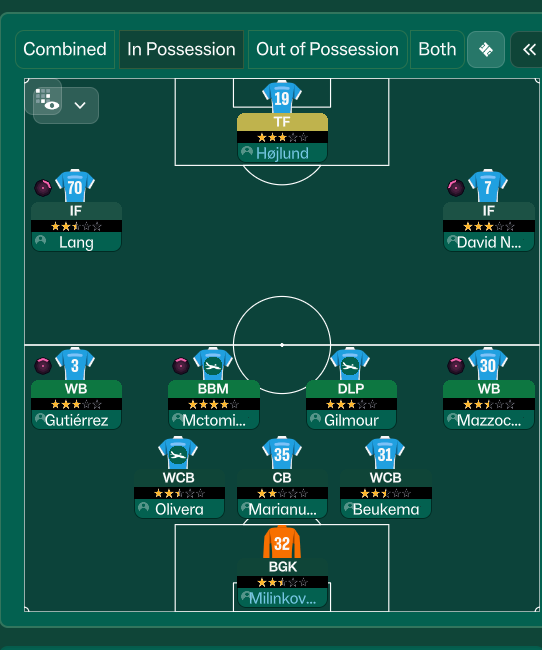


FM 26 Out of Possession


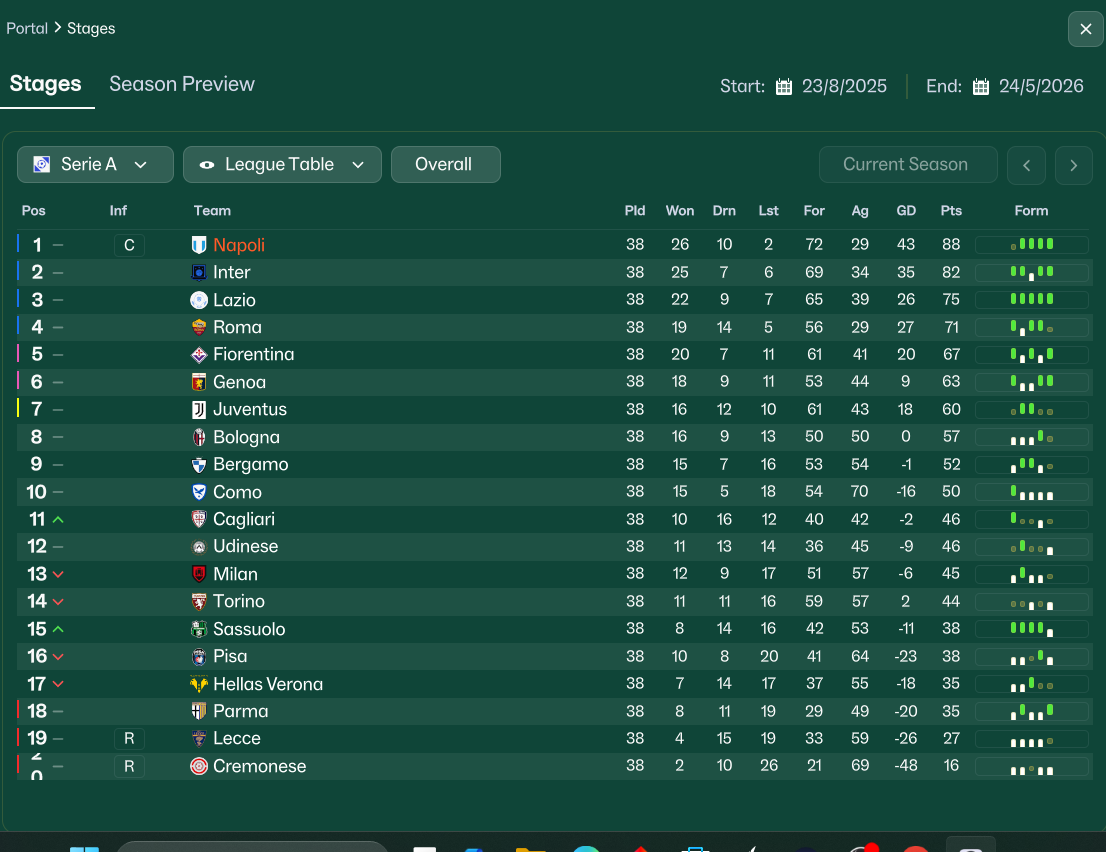
Stats FM 26 Napoli season 2025-26


Download Now
Downloads: 47 / Added: 2025-12-05
Your content on FM Scout

We are always looking for quality content creators, capable of producing insightful articles. Being published here means more exposure and recognition for you.

Do YOU have what it takes?

Discussion: Antonio Conte's New 3-4-2-1 Won the Italian Treble

1 comments have been posted so far.

FMS Chat

Stam
hey, just wanted to let you know that we have a fb style chat for our members. login or sign up to start chatting.