


3rd Place Premier League Finish – One Season Tactical Overachievement
.thumb.png.ef077a38ca6f2ec88332df5cb81e056f.png)
.thumb.png.66ff7fb782904ea43cfd528503352e69.png)
.thumb.png.0772c9ac77ff334a20a570eda76da51b.png)
.thumb.png.96423fb99047d1e05672dd8e0ad308dd.png)
.thumb.png.8ae26ca17d321c217a1cfef25a7562b2.png)
GAME STATUS IMAGE im going to make a rebuild that why its says next season
.thumb.png.5dae36db605205f6b957bf3e295ec7a6.png)
2nd test
.thumb.png.79da7cb29f0b91908ff92b1e035a9ee9.png)
.thumb.png.9303d846fd82ae20756aec0116d8eb24.png)
.thumb.png.6fe7e2ab55b09012b829aebbeac3f728.png)
.thumb.png.478a449286fea88239d4facf279a35aa.png)
.thumb.png.c14a321a4c339a9c0fb7a5d87bceaf48.png)
.thumb.png.913459ab97ad8e51d36fefb7db0b6c8a.png)
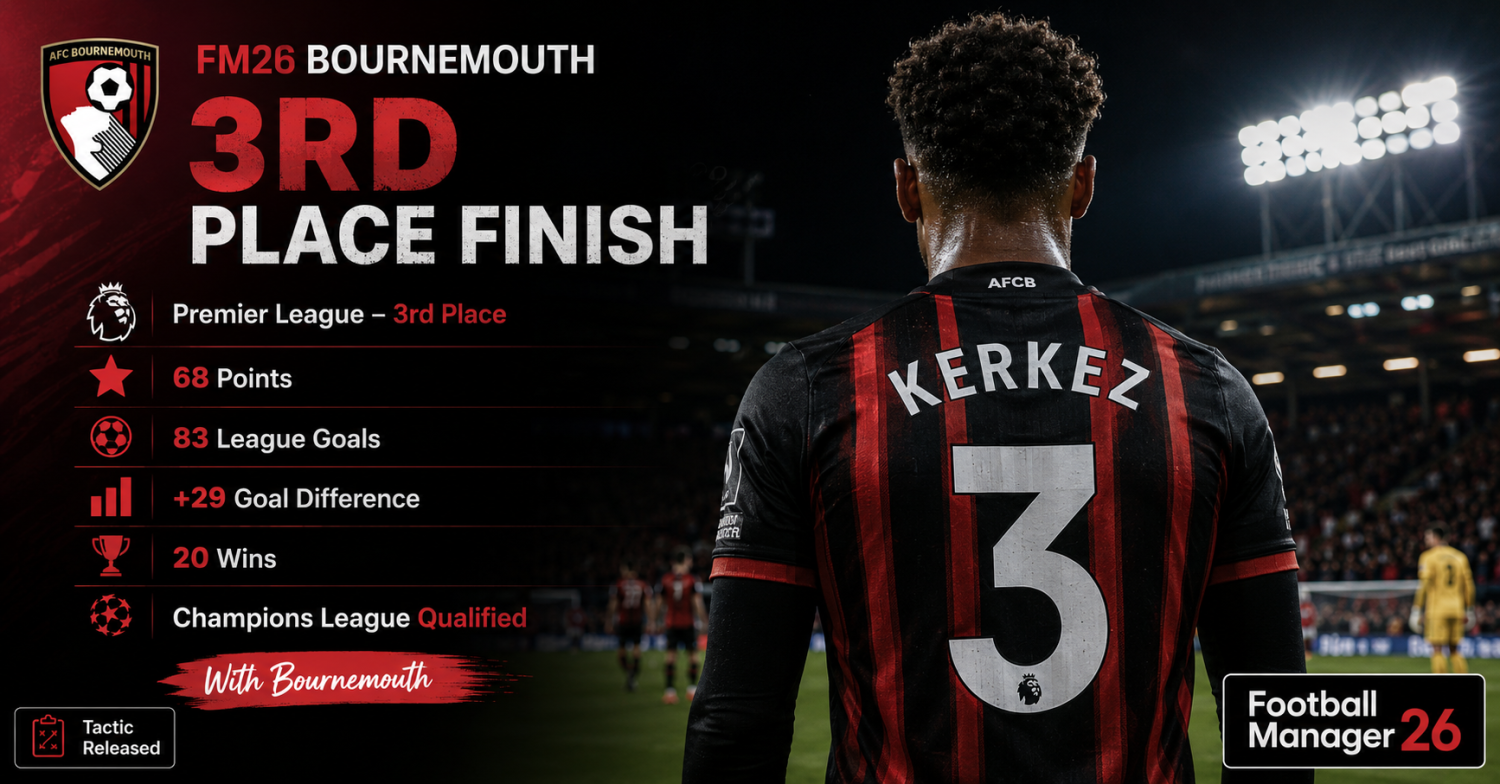
This Bournemouth save produced one of the strongest underdog results of the season, finishing 3rd in the Premier League and qualifying for the Champions League.
The final league table shows the scale of the achievement clearly. Bournemouth ended the season with 68 points from 38 matches, winning 20 games, drawing 8, and losing only 10. The team scored 83 goals and conceded 54, finishing with a +29 goal difference.
Only Manchester City and Liverpool finished above Bournemouth. Arsenal, Chelsea, Spurs, Aston Villa, West Ham, Manchester United and Newcastle all finished below.
This was not a defensive survival tactic. This was an aggressive, high-output system built to attack, overload wide areas, create chances quickly and give Bournemouth enough firepower to compete with the best teams in the league.
League Performance
Bournemouth’s league campaign was built on strong attacking numbers. Scoring 83 goals in a Premier League season with this squad is the main headline. The tactic allowed the team to play above its natural level, especially in matches where Bournemouth could force transitions and attack space behind the opposition.
The defensive record was not perfect, with 54 goals conceded, but that is expected from an attacking setup using an ambitious mentality. The trade-off was clear: Bournemouth were willing to take risks, but the attacking return was strong enough to carry the team into the top three.
Important results from the season included:
Bournemouth 4-1 Brighton
Bournemouth 4-2 Newcastle
Bournemouth 3-0 West Ham
Manchester United 2-3 Bournemouth
Bournemouth 2-1 Arsenal
Bournemouth 1-0 Spurs
Bournemouth 2-1 Manchester United
Bournemouth 1-0 Manchester City
Nottingham Forest 1-2 Bournemouth on the final day
The final match against Nottingham Forest secured the strong finish, with Bournemouth winning 2-1 away from home.
Tactical Shape
The tactic used a very interesting structure. In possession, the team looked like a narrow attacking system with aggressive wing-back support.
The main attacking shape included:
Goalkeeper
Two centre-backs
Two attacking wing-backs
One deep-lying midfielder
Central midfield support
One attacking midfielder
Two wide attacking midfielders
One central striker
Out of possession, the system became more compact and structured. The wide players dropped into wider midfield zones, while the wing-backs became deeper full-backs. This gave the tactic a better defensive base without completely sacrificing attacking threat.
The system is not a simple park-the-bus tactic. It is a proactive attacking setup that tries to control possession while still maintaining enough vertical threat through the striker and wide midfielders.
Mentality and Style
The tactic used an Attacking mentality with a Control Possession base.
That combination is important. It means the team was not just throwing bodies forward randomly. The intention was to keep the ball, build attacks with structure, and then use the wide players and wing-backs to stretch the pitch.
The attacking mentality helped Bournemouth push higher, commit more players forward, and create more scoring chances. But because the base style was Control Possession, the team still tried to play with some patience rather than relying only on direct football.
This balance is likely one of the main reasons the tactic worked so well across a full Premier League season.
Key Player Performances
The squad performance was well spread across multiple players, which is usually a good sign for a tactic. It was not completely dependent on one superstar carrying everything.
Evanilson
Evanilson was the main attacking weapon of the season.
He finished with:
34 appearances
23 goals
4 assists
7.15 average rating
For a Bournemouth striker, that is an excellent return. The role clearly gave him enough central presence to finish chances regularly. He also scored in the final match against Nottingham Forest, showing how important he was in decisive moments.
Alex Jimenez
Alex Jimenez was one of the biggest tactical engines in the system.
He produced:
40 appearances
9 goals
15 assists
7.06 average rating
That is a huge return from a wing-back. His role was clearly very attacking, giving Bournemouth width, crossing threat and late movement into dangerous areas.
Adam Smith
Adam Smith also had an outstanding season from the right side.
He produced:
43 appearances
5 goals
15 assists
6.97 average rating
Both wing-backs finishing with 15 assists shows exactly how the tactic created chances. The wide areas were a major source of creativity.
David Brooks
David Brooks gave strong attacking depth and rotation value.
He finished with:
26 starts and 15 substitute appearances
8 goals
10 assists
7.01 average rating
His numbers show that the tactic did not only work with the first eleven. Rotation players were also able to contribute.
Luis Sinisterra
Sinisterra had the highest average rating shown in the squad list.
He produced:
23 starts and 2 substitute appearances
10 goals
4 assists
7.31 average rating
Even though he was injured at the time of the screenshot, his season output was excellent.
Justin Kluivert
Kluivert was another important contributor from the left/attacking midfield area.
He recorded:
36 starts and 1 substitute appearance
9 goals
10 assists
6.83 average rating
His role helped connect midfield and attack while adding another goal threat behind the striker.
Why the Tactic Worked
The biggest strength of this tactic was the wide overload.
Both wing-backs were heavily involved in the final third, and the wide attacking midfielders helped create multiple passing lanes. This meant Bournemouth could attack with width while still keeping central options through the striker, attacking midfielder and central midfielders.
The striker was not isolated. Evanilson had support from both sides and from the attacking midfielder behind him. That is why he reached 23 league goals.
The midfield also gave the tactic balance. Lewis Cook and Tyler Adams offered work rate, defensive protection and passing stability. This mattered because the wing-backs were aggressive. Without that midfield base, the tactic could easily become too open.
The centre-backs also had to handle a lot of defensive responsibility. Bournemouth conceded 54 goals, so the system was not flawless defensively, but it created enough attacking pressure to win more games than expected.
Strengths
The main strengths of the tactic are:
Very strong attacking output
Excellent wing-back productivity
High goal return from the striker
Good chance creation from wide areas
Strong against bigger teams when transitions open up
Capable of overachieving with a mid-table squad
Rotation players still perform well inside the system
Weaknesses
The tactic is aggressive, so it does have some risks.
The team conceded 54 goals, which means this is not a defensive masterclass. Against elite teams or fast counter-attacking sides, space behind the wing-backs can become a problem.
There were also some heavy defeats, including a 5-0 loss away to Arsenal and a 4-1 loss away to Liverpool. That shows the tactic can be punished if the opponent breaks through the first wave of pressure.
This tactic is best suited for managers who are comfortable accepting some defensive risk in exchange for high attacking output.
Best Type of Players for This Tactic
To make this system work properly, the most important positions are:
Striker
You need a striker who can finish chances consistently. Evanilson scored 23, so this role is central to the tactic.
Wing-backs
This is probably the most important area of the tactic. Both wing-backs need stamina, pace, crossing, attacking movement and decent defensive ability. Alex Jimenez and Adam Smith both delivered 15 assists, which proves how important this role is.
Defensive Midfielder
The defensive midfielder must protect the centre-backs and cover space when the wing-backs push forward. Lewis Cook was important here.
Wide Attacking Midfielders
The wide players need to contribute with goals and assists. Kluivert, Brooks and Sinisterra all helped keep the attacking output high.
Final Verdict
This Bournemouth tactic delivered a massive overachievement by finishing 3rd in the Premier League and qualifying for the Champions League.
The team scored 83 goals, finished with 68 points, and outperformed several clubs with stronger squads. Evanilson was the main finisher, while the wing-backs were the creative engine of the system.
This is an attacking tactic with risk, but the reward is clear. It can push a mid-table Premier League squad into elite territory if the right players are used in the key roles.
For managers who want aggressive football, high scoring matches, and serious overachievement with an underdog team, this Bournemouth save is a strong example of how far a well-built attacking system can go.
Game file
Enter text for the link here...

![FM26 International fixes & Nationalities update [Final Version out]](assets/downloads/fm26/fm26-international-fixes-and-nationalities-update.th.jpg)



![FM26 Data Tweaks [v3.6 | v5.2]](https://fmdatatweaks.com/wp-content/uploads/fmdt-cover.webp)



Discussion: Bournemouth 3rd Place Attacking Tactic FM26 V2
No comments have been posted yet..