


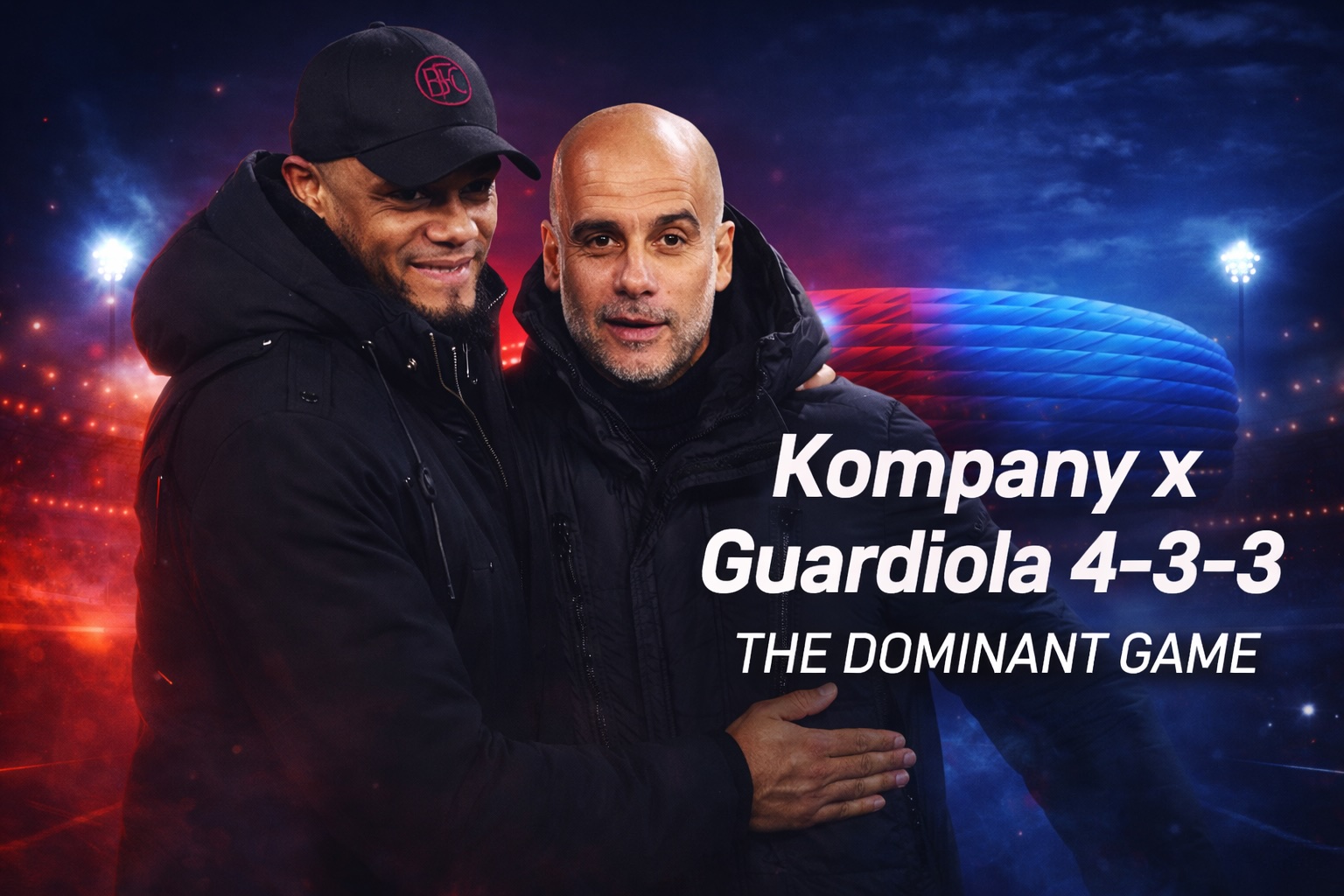
I know that many players are looking for a realistic, possession-based tactic that not only looks good on paper, but actually works within the Football Manager match engine. At the same time, a lot of systems rely heavily on counter-attacking football, which often feels repetitive and less reflective of modern elite teams.
With this tactic, I wanted to take a different path. The goal was to create something new, something that reflects real-life football at the highest level, while still being highly effective in FM26. This system is inspired by Pep Guardiola’s positional dominance and Vincent Kompany’s aggressive, progressive evolution of that philosophy.
It is built to control matches through possession, while applying constant pressure without the ball. The result is a style that feels both structured and expressive, combining discipline with creative freedom and maintaining dominance in every phase of the game.
⚙️ Formation & Structure
The base shape is a 4-3-3 (4-1-2-3 Wide), but the real strength of the system lies in how it behaves dynamically. In possession, the team becomes compact in central areas, creating numerical superiority and strong connections between the lines. Fullbacks push high to provide width, while the midfield forms natural triangles to ensure constant passing options.
Out of possession, the shape transforms into a compact pressing unit that closes down space aggressively and forces opponents into mistakes. The system is always oriented around one principle: control through structure and intensity.


🏗️ Build-Up Play
The build-up is heavily influenced by Guardiola’s positional play. The team starts from the back with short distribution, using ball-playing defenders and a deep-lying playmaker to orchestrate the first phase.
-
[]Short goal kicks and controlled circulation
- Strong central presence to dictate tempo
[]Constant triangle creation for safe progression
What makes this system different is the Kompany influence. The build-up is not passive or slow. Instead, it is progressive and intentional. Players are encouraged to carry the ball forward, break lines when possible and constantly look for solutions that move the team up the pitch.
🚀 Progression
Progression through midfield is where the balance between structure and aggression becomes most visible. The team combines short passing with vertical intent, always looking to advance rather than recycle.
-
[]Quick combinations in tight spaces
- Supporting runs from midfield and wide areas
[]Vertical passes into advanced zones
The narrow attacking setup creates dominance in central areas and especially in the half-spaces. Kompany’s influence adds a more direct edge here, with players actively attacking space and increasing tempo when opportunities arise.
This ensures the system remains controlled, but never predictable.
🎯 Attacking Play
In the final third, the focus shifts to precision, patience and intelligent movement. The team works the ball into the box, prioritizing high-quality chances over speculative efforts.
-
[]Short passing combinations in the final third
- Movement between defensive lines
[]Low crosses and cutbacks
The front line is fluid and dynamic. Inverted wingers cut inside, the striker links play and occupies defenders, while midfielders arrive late into dangerous areas.
Here, the balance between Guardiola and Kompany becomes clear. The structure ensures positional discipline, while the system allows for creative freedom and spontaneous movement, making the attack both controlled and unpredictable.
🔥 Defensive Play
Without the ball, the system becomes highly aggressive. The aim is not to sit back, but to actively regain possession as quickly as possible.
-
[]High pressing line
- Compact team shape to close passing lanes
[]Intense pressing triggers
This reflects Guardiola’s counter-pressing philosophy, but with an added layer of Kompany’s mentality: more aggression, more physicality and a fearless approach to defending high up the pitch.
The team compresses space and constantly forces opponents into difficult situations.
⚡ Transition Play
Transitions are a key strength of this system and a major reason why it feels so dominant in FM26.
-
[]Immediate counter-press after losing the ball
- Fast reactions across the entire team
[]Quick forward options after regaining possession
Kompany’s influence is especially important here. Transitions are not treated as neutral phases, but as opportunities to attack. The team looks to exploit moments of imbalance quickly and decisively, maintaining constant pressure on the opponent.
🧩 Positional Play & Movement
The entire system is built around intelligent positioning and coordinated movement. Players are constantly adjusting their positions, offering passing options and creating space for others.
-
[]Occupation of key zones across the pitch
- Continuous off-ball movement
[]Creation of triangles and overloads
Guardiola’s positional discipline ensures structure and balance, while Kompany’s ideas add more verticality, more tempo shifts and more attacking intent.
The result is a system that feels fluid, dynamic and extremely difficult to defend against.
🏁 Final Concept
This tactic represents a fusion of two elite footballing philosophies. On one side, Guardiola’s control, structure and positional dominance. On the other, Kompany’s intensity, bravery and forward-thinking aggression.
It is a system designed to control the game, dominate space and apply relentless pressure, while creating consistent attacking superiority.
A modern, realistic FM26 tactic built for total control and high-intensity football.







Discussion: Kompany x Guardiola: 4-3-3 - The dominant game V2
3 comments have been posted so far.
[img]https://ibb.co/BVmqnsbk[/img][img]https://ibb.co/3mtR6h0Q[/img]